
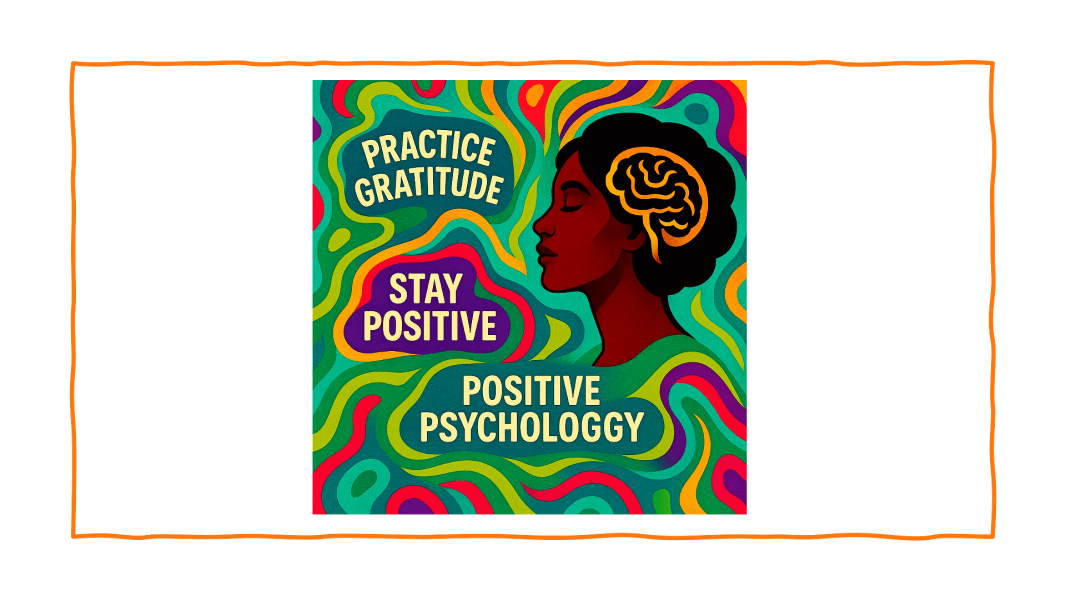
Let’s get one thing straight:
Positive psychology is not telling you to “just think happy thoughts” while the world is burning.
It’s not about ignoring the chaos. It’s about building a mental toolkit strong enough to walk through it without losing yourself.
We’re not talking about wishful thinking. We’re talking about evidence-based, brain-backed mental training. Because optimism isn’t a personality trait. It’s a skill — and one you can teach your brain to practice.
And guess what? AI can help.
☀️ So What Is Positive Psychology?
It’s the science of what makes humans thrive — not just survive. Founded by Martin Seligman and expanded by researchers across the globe, positive psychology studies well-being, hope, purpose, gratitude, flow, connection, and other things that make life worth living (even when everything feels like a mess).
It asks the question:
“What’s right with you — and how do we build from there?”
💣 What It’s Not (and Why That Matters)
Let’s be very clear:
- It’s not about ignoring pain.
- It’s not about suppressing anger, grief, or burnout.
- And it’s definitely not about smiling through a mental health crisis because your vision board says so.
That’s toxic positivity — and your nervous system deserves better.
Positive psychology meets you in the mess, looks around, and says:
“Okay. What strengths do we still have to work with?”
“Where can we find meaning in this chaos?”
“What can we control — even if it’s just today’s story?”
🧠 How It Changes Your Brain
Real talk: Your brain is a prediction machine. It’s constantly scanning for patterns based on past experiences. And in a disrupted world, it often defaults to worst-case-scenario thinking.
But here’s the magic: Practices like gratitude, savoring, and reframing don’t just feel good — they retrain your brain’s default wiring.
Neuroscience calls it experience-dependent neuroplasticity. I call it reclaiming your mental bandwidth.
These tiny practices:
- Strengthen your prefrontal cortex (decision-making, emotion regulation)
- Reduce activity in the amygdala (fear + reactivity)
- Increase dopamine + serotonin (motivation, mood, creativity)
🧪 Gratitude practice promotes neuroplasticity, increasing gray matter in areas responsible for decision-making and emotion regulation (Saffron Sage). It also boosts dopamine and serotonin — your natural happiness chemicals
🤖 AI Isn’t Just for Scheduling — It’s Coaching Your Brain Now
We’re already using AI to plan our day — but what if we used it to protect our minds?
Tools like Replika and Wysa go way beyond chatbot novelty. They’re trained in cognitive behavioral therapy (CBT) and emotional support, meaning you can talk to a digital companion who listens, reframes, and even helps you sort through your thoughts without judgment (or copay).
🧪AI-powered mental health chatbots have been shown to reduce symptoms of depression by up to 64% in a recent meta-analysis (Augnito).
And then there’s Notion — not just for productivity nerds. Used intentionally, it becomes a customizable mental health dashboard:
- Gratitude logs
- Morning mindset check-ins
- Weekly reflections
- Mood-to-action trackers
And now, some rising stars worth spotlighting:
- Mindsera: AI journaling that reads between the lines — literally. You write, it visualizes your mindset and uncovers patterns.
- Youper: A gentle, AI-powered therapist in your pocket — mood tracking, reframing, and emotional insight.
- Kintsugi: Speak your thoughts, and the AI detects emotional tone and flags stress before you even catch it.
- neuroflash: Daily affirmations, strength-focused prompts, and content coaching rooted in behavioral science.
- Twill by Dario (Happify): Emotional fitness games + AI-guided tracks for resilience, grounded in positive psychology research.
These tools aren’t here to replace your inner wisdom. They’re here to help you practice it more often and with fewer barriers.
🧪 The AI in mental health market was valued at $1.13 billion in 2023 and is projected to grow at 24.1% CAGR through 2030 (Grand View Research).

🛠️ Build Your Positivity Stack (No Woo Required)
Start with this:
- What helps you feel grounded in chaos? (That’s your anchor.)
- What gives you energy — even just 1%? (That’s your access point.)
- What AI tool could help you do either, faster or more consistently?
Your tech stack can be more than email, project management, and Slack. It can include emotional hygiene, purpose, and joy.
🔁 What This Isn’t — And Why It Works
This isn’t about “being positive.” It’s about training your brain to respond to chaos with more flexibility and less panic.
It’s not about avoiding pain. It’s about building the psychological muscles to move through it.
And no, AI can’t heal trauma — but it can help create daily structures, reflections, and nudges that support healing work.
🧪 In a recent 8-week study with college students, use of the AI journaling app MindScape led to a 7% increase in positive affect and 11% reduction in negative affect (arXiv.org).
💬 Final Thought
The world doesn’t need more fake optimism. It needs people with resilience, emotional intelligence, and tech tools that actually support their mental health.
This isn’t fluff. It’s strategic survival — backed by science, fueled by intention, and designed for a world that keeps disrupting itself.
Now you: What’s one AI tool, ritual, or micro-practice that’s helped you stay emotionally grounded lately?
Drop it in the comments — let’s build the new emotional operating system, together.